Insights · The playbook

The AI answer
playbook.

How UK law firms get found, cited and recommended by AI answer engines. This is the working playbook we use at Headnote Studio - published in full, because the judgement is in applying it, not knowing it.

A note on the numbers, before anything else. Most published GEO statistics come from vendor research - useful for direction, not warranted effect sizes. The independent anchors are the Princeton GEO study (KDD '24) and the GEO-SFE academic study (2026); where we quote a figure below, treat it as directional and follow the source. That is the same evidence discipline we apply to client reports.

01 · The strategic shift

From ten blue links
to one answer.

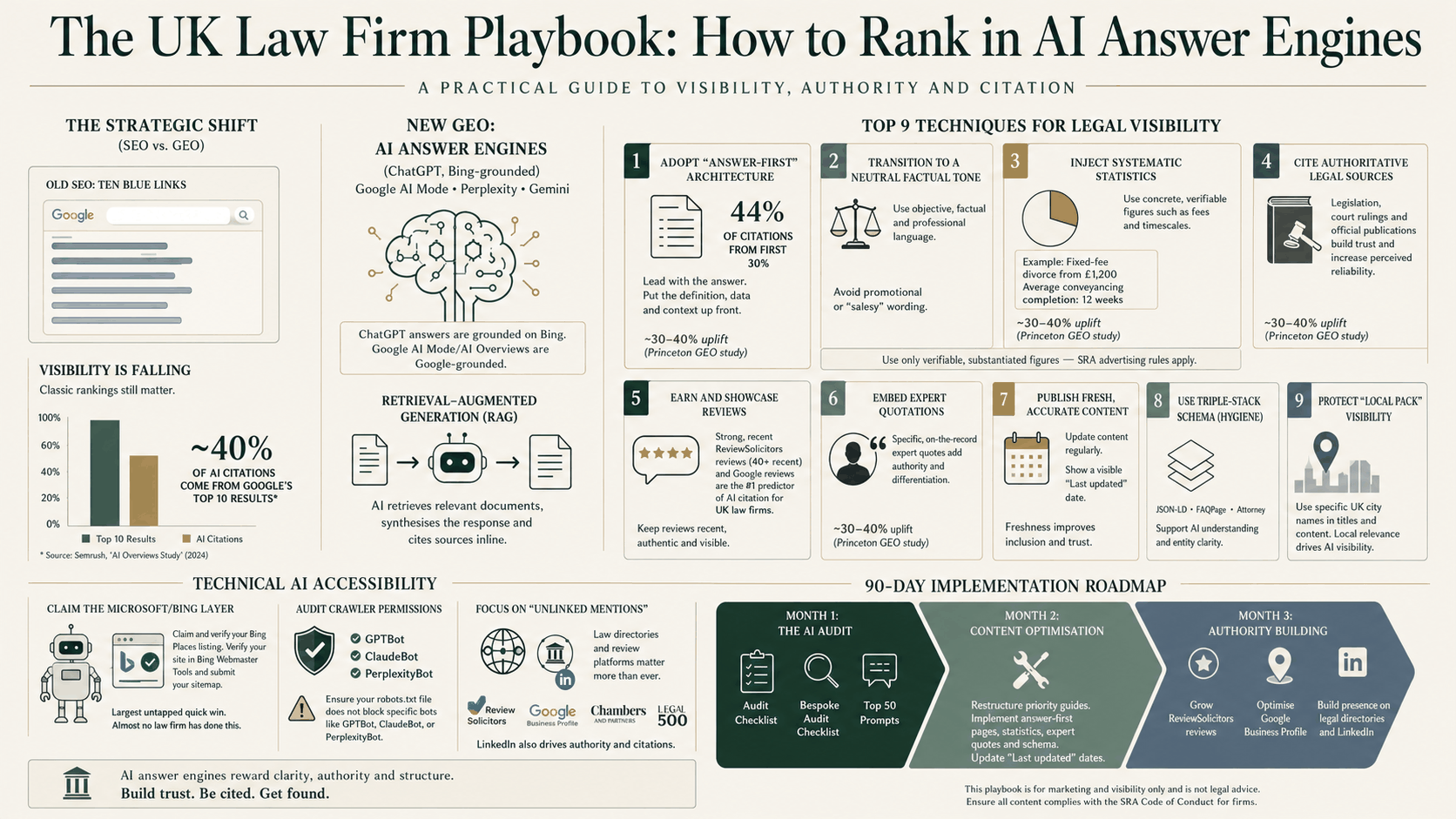
Classic search returned a page of links and let the client choose. AI answer engines - ChatGPT, Google's AI Overviews and AI Mode, Perplexity, Copilot - retrieve what has been published about local firms, synthesise it and reply with a shortlist. The choosing has partly moved into the machine.

Classic rankings still matter: in one large vendor analysis (Semrush, 2024), roughly 40% of AI citations came from Google's top-ten results - so SEO and GEO are complements, not rivals. But the mechanism has changed. The engines read your Google Business Profile, your reviews, the legal directories and your own pages, then quote what is clear, factual and attributable.

Family and conveyancing queries are among the most AI-active in the studies we track - if those are your practice areas, this is already happening to your enquiries.

THE QUESTION THE ENGINE READS THE SHORTLIST “Best family solicitor near me?” asked of ChatGPT or Google's AI § Google Business Profile § Reviews & ratings § Legal directories § Your website § Bing & the Microsoft layer 1 - Firm A 2 - Firm B 3 - Firm C …is your firm on it?
Retrieval-augmented generation, in practice: the engine reads, synthesises and cites

02 · Where the answers come from

Grounding -
and getting read at all.

ChatGPT grounds its answers on Bing. Google's AI Overviews and AI Mode ground on Google. That single fact reorders the to-do list: claiming and verifying your Bing Places listing, verifying Bing Webmaster Tools and submitting your sitemap is one of the cheapest visibility moves available - and it is routinely unclaimed among the firms we test.

Then check you're readable at all. A firm can pay for content its own infrastructure hides from the engines: a robots.txt or CDN that blocks GPTBot, ClaudeBot or PerplexityBot; nosnippet directives on practice pages; content rendered only in JavaScript. Audit crawler access before any content work.

Unlinked mentions count. The engines lean on the sources they trust for the sector: ReviewSolicitors, Google Business Profile, Chambers, Legal 500 and LinkedIn among them. Consistent name, address and practice-area detail across those profiles is entity-building, even without links.

03 · The nine techniques

What actually moves
citation.

01

Answer first

Put the answer in the first paragraph: definition, key facts, then context. In one 1.2-million-citation analysis, ~44% of ChatGPT citations came from the first 30% of a page.

02

Neutral, factual tone

Engines select objective, verifiable statements. Promotional or “salesy” wording reads as noise - write like a good practice note, not an advert.

03

Verifiable specifics

Concrete fees, timescales and counts beat hedged generalities - among the strongest levers in the Princeton study. Every figure must be accurate, current and SRA-compliant.

04

Cite authoritative sources

Link legislation, court guidance and SRA publications. Cited sources were one of the top-scoring levers in the independent academic work.

05

Real reviews, kept recent

Recency joins volume: UK data links a strong, recent flow of ReviewSolicitors and Google reviews with citation. A correlation, not a promise - but reviews are cheap, compliant and defensible.

06

Named experts, quoted

On-the-record quotes from named solicitors - real name, SRA number, not “the team” - add authority and differentiation the engines can attribute.

07

Fresh, dated content

Update priority pages regularly and show a visible “last updated” date. Freshness improves inclusion and reader trust alike.

08

Schema, as hygiene

JSON-LD @graph, FAQPage and LegalService markup support entity clarity. Cheap to deploy, weak-positive evidence - do it, but never buy it as a headline service.

09

Local entity clarity

Firm name, town and practice area in the sentence itself, on every priority page. Self-contained passages quote well - and local relevance drives AI shortlists.

04 · The first 90 days

A roadmap, not
a scatter-gun.

Month one is the audit: entity snapshot, technical crawler audit and an engine baseline of repeated, dated captures - because a single search proves nothing. Month two is optimisation: entity and Microsoft-layer hygiene, answer-first restructuring of priority pages, schema and visible dates. Month three is authority: review momentum, directory consistency, expert quotations - and the first re-tests against the baseline.

Diagnose & baseline Entity, location & Microsoft hygiene Reviews engine Answer-shaped content Prove & re-test Wk 0 2 4 6 8 10 12
The delivery spine we run engagements on - segments tune it, the sequence holds

Sequence matters: hygiene is fast and provable, reviews take weeks to compound, content is the slowest lever to prove. Run them in that order and each phase's evidence funds confidence in the next.

Plain answers

Questions,
answered.

What is generative engine optimisation (GEO)?

GEO is the practice of making a firm's public information easy for AI answer engines to read, trust and cite - so the firm appears when ChatGPT or Google's AI writes a shortlist. It covers entity and location data, reviews, content structure and technical access, not just keywords.

Which AI engines matter most for a UK law firm?

ChatGPT, Google's AI (AI Overviews and AI Mode) and Google's local results carry the most weight today, with Claude, Microsoft Copilot and Perplexity worth checking weekly. ChatGPT grounds its answers on Bing, so the Microsoft layer matters far more than its search share suggests.

Do these techniques guarantee a citation?

No. Most published GEO statistics are vendor research, and engine behaviour changes without notice - the honest claim is direction, not magnitude. That is why results should be measured with repeated, dated, logged-out runs against a baseline, and why we guarantee our fee, never a ranking.

What should a law firm do first?

Three checks that fit in an afternoon: confirm your robots.txt and CDN are not blocking AI crawlers such as GPTBot, ClaudeBot and PerplexityBot; claim your Bing Places listing and verify Bing Webmaster Tools; and get genuine, recent reviews flowing on the platforms the engines read. Content work comes after.

This playbook is marketing and visibility guidance only - it is not legal advice, and anything a firm publishes must comply with the SRA Code of Conduct. AI answer engines reward clarity, authority and structure: build trust, be cited, get found.

Knowing is free · doing is the work

See where your firm
stands today.

A one-page snapshot of how your firm appears across the main AI assistants, with dated screenshots - free for eligible UK law firms. No meeting, no follow-up sequence.